
Friday, February 6, 2015
Form Meets Function Reflection Post
For this project, I intended on the wheel cap to be mostly black or silver, depending on what the consumer wants. I made this product to be 20". The fan shaped rims are meant to help cool down brakes. It started with the outer rims and I designed the fan to fit inside. It meets the design meets function requirement because regular wheel caps are just meant for looks and do not have much function other than holding the wheel up. The design reminds me of a fan because that was the points of the design, and turns when the wheel is moving. It is pretty similar to many designs out there with flat spokes pointing outwards in the wheel, but my design is curved and intakes air from outside, so it has a function. I think this design could be better if I can actually test the fans to see how much air it needs to take in and design the fan to take in air without slowing down the car. As of now, it is only a concept without any improvements.

Monday, February 2, 2015
Puzzle Cube Reflection
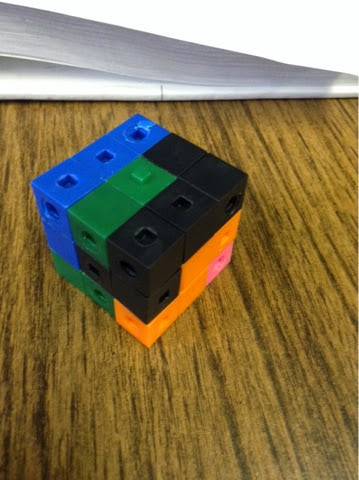
I timed 9 people for solving the cube, and many more attempted on trying to solve my cube. Only 3 people solved my cube. I timed out for people who took more than 16 minutes.
Solved:
Sonia: ~1min
Paras: ~2 min (claimed)
Mikkayla: ~10 min
Unsolved:
Mr Ho: ~5min
Sukhjit: 3 min 54 sec
William: 16 min
Aasish: ~25 min
Sruthi: ~30 min
Archit: 16 min

Mean: 11.43 minutes
Median: 13 minutes
Mode: 16 minutes
Range: 15 minutes
Standard Deviation: 9.22316
Reflection Questions:
1. It is important to model an idea before finalizing it because it is costly to make a full scale and take the risk of possibly re-doing it because there was an error or something you didn't want.
2. I love the piece that is completely locked in the middle because it cannot be moved without removing another piece of the cube.
3. One thing I would change about my puzzle is that there were two pieces that didn't really connect with the other pieces and were not interlocking. I wish I made it interlocking to make the cube more of a challenge.
Solved:
Sonia: ~1min
Paras: ~2 min (claimed)
Mikkayla: ~10 min
Unsolved:
Mr Ho: ~5min
Sukhjit: 3 min 54 sec
William: 16 min
Aasish: ~25 min
Sruthi: ~30 min
Archit: 16 min
Mean: 11.43 minutes
Median: 13 minutes
Mode: 16 minutes
Range: 15 minutes
Standard Deviation: 9.22316
Reflection Questions:
1. It is important to model an idea before finalizing it because it is costly to make a full scale and take the risk of possibly re-doing it because there was an error or something you didn't want.
2. I love the piece that is completely locked in the middle because it cannot be moved without removing another piece of the cube.
3. One thing I would change about my puzzle is that there were two pieces that didn't really connect with the other pieces and were not interlocking. I wish I made it interlocking to make the cube more of a challenge.
Wednesday, January 21, 2015
Intro To Design Final Portfolio
Brainstorm

While brainstorming, we thought of all the pieces possible for fitting in a 3x3 cube. This helped us think about what pieces to use and what pieces we could possibly use. We made these combinations with 3 cubes, 4 cubes, 5 cubes, and 6 cubes. There should be more combinations but we decided to move onto the next stage of the design process. Each of the cubes are 3/4 inch, and there are a total of 27 cubes. There is a limit of 5 pieces in the cube.
Cake Layers


I chose this design because it had more interlocking pieces and it met all the constraints for making the cube. In addition, this cube is much harder to solve in my opinion, giving my classmates a challenge.
Multi-view Sketches of Parts

I had four people from other classes attempt to solve the puzzle, and they spent an entire lunch period trying to solve it, but they didn't solve it until after I showed them.
Multi-view of Cube




Inventor

The files for the inventor pieces and assembly is here.
In this design process, the only thing I have not done is the drawings on Inventor. I feel like this design process was very thorough and detailed, and it really helped me design my cube overall. I think the cube is rather well done because so far, only one person other than me has managed to put the cube together, and it was with a little bit help.
Thursday, January 8, 2015
Cube Quality Control
We were given 27 3/4 inch cubes, and we used a dial caliper to measure one side of every cube. We recorded the data to the nearest 0.001 of an inch. The data is pretty well distributed except for a few.

| Mean:0.746363 |
| Median:0.746363 |
Mode:0.7478
|
Wednesday, December 17, 2014
Fling Machine Reflection
Data Recorded: 15', 18', 20', 20', 22', 16', 18', 19', 21'


It is pretty well distributed with 18, 19, 20 feet in the middle.
Mean: 18.8'
Median: 19'
Range: 7
Sample Standard Deviation: 2.1499
I predict that most of the cotton balls will launch between 18-20 ft based on the data we received from the tests we tried.
It won't be improved with the performance of alternate device comparison because the original data will still be the same.
I actually prefer giving points for distance traveled since we were 2nd farthest, but if I was to recommend, I would recommend finding the average of the test launches for points, and originality.
I would have made our plane more dense and smaller, and made it easier to fly. I thought throwing the entire device all together was bending the rules too much.
We only used aluminum foil and cotton balls, so the only reduction would be in size.
To improve our team, I could try to use some of my partner's idea if they were any good.
Wednesday, December 10, 2014
Unit Conversions
In this project, we made a presentation about accuracy and precision, US and SI units, Dimensional Analysis, Significant Figures, and Rules of Exponents. The link to the presentation is here. We accidentally skipped the slide which showed accuracy and precision.
From this project, all the unit conversions seemed to be a little more exciting, but it is still going to be boring as ever, because it is long and no fun.
From this project, all the unit conversions seemed to be a little more exciting, but it is still going to be boring as ever, because it is long and no fun.
Friday, November 14, 2014
Color Theory

A color scheme is an arrangement or combination of colors, especially as used in interior decoration. The different kinds of color schemes are monochromatic colors which creates a soothing effect which makes an overall mood, analogous colors which uses a color as a dominant color and adjacent colors to surround it, complementary colors which have opposite colors on the color wheel put next to each other, and split complementary is a variation of complementary colors two adjacent colors are matched against its opposite color. A color triad is any combination of three colors on the color wheel.
The three primary colors are red, blue, and yellow.
The three secondary colors are violet, orange, and green.
The six tertiary colors are blue green, blue violet, red violet, red orange, yellow orange, and yellow green.

Examples of Color Schemes:
Monochromatic color:

Analogous color:

Complementary color:

Triadic Colors:

Split complementary color:

 This is Amijot's Kaleidoscope.
 This is my kaleidoscope.
Subscribe to:
Posts (Atom)